
.png?width=300&name=SAGC%20Seminar%20June%2010th%20-%20Spatial%20+%20Tumour%20Microenvironment%20(6).png)
Post-Event Summary: High-Resolution Spatial Transcriptomics
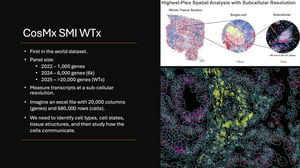
Exploring Approaches to Spatial Data Analysis with CosMx
Researchers interested in high-resolution spatial biology can now watch the recording of SAGC's recent seminar exploring the latest advances in spatial transcriptomics and computational analysis of the tumour microenvironment.
Held at SAHMRI, the seminar featured two computational biologists working at the forefront of spatial biology. The presentations highlighted how high-plex spatial transcriptomics is enabling researchers to map cellular organisation, uncover mechanisms of disease, and identify clinically relevant biomarkers that were previously inaccessible using conventional sequencing approaches.
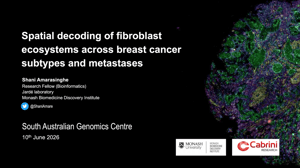
Dr. Shani Amarasinghe, Research Fellow (Bioinformatics), Monash Biomedicine Discovery Institute
Cancer-associated fibroblasts (CAFs) are a major component of the breast cancer tumour microenvironment, yet their diversity and role in disease progression remain poorly understood. In this presentation, Dr Shani Amarasinghe demonstrates how CosMx spatial transcriptomics was used to dig deeper into the spatial organisation of fibroblast heterogeneous populations across multiple breast cancer subtypes and matched metastatic tissues.
The presentation showcases an end-to-end spatial transcriptomics workflow—from experimental design and data quality assessment through to cell type annotation, niche analysis and biological interpretation. The study reveals seven distinct cancer-associated fibroblast states and shows how their spatial distribution and interactions with neighbouring tumour and immune cells change across tumour progression and metastatic spread, providing new insights into breast cancer biology and potential prognostic markers.
Key topics include:
-
Mapping cancer-associated fibroblast (CAF) diversity with CosMx Spatial Transcriptome profiling
-
Spatial organisation of fibroblasts across breast cancer subtypes and lymph node metastases
-
Identifying seven distinct CAF states and their relationship to disease progression
-
Spatial niche analysis to investigate tumour–stromal interactions
-
How spatial transcriptomics is revealing new biomarkers and therapeutic opportunities in breast cancer
Part 3 - Spatial transcriptomics to predict immunotherapy response in NSCLC
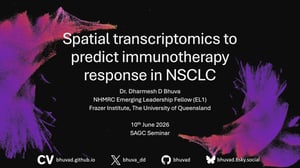
Dr Dharmesh D. Bhuva
Frazer Institute, The University of Queensland
Immunotherapy has transformed the treatment of non-small cell lung cancer (NSCLC), yet existing biomarkers such as PD-L1 expression and tumour mutational burden (TMB) remain imperfect predictors of patient response. In this presentation, Dr Dharmesh Bhuva demonstrates how their group is using whole-transcriptome spatial profiling to better understand the tumour microenvironment and uncover new biomarkers that may improve patient stratification for immunotherapy.
Using CosMx Whole Transcriptome (WTx) datasets, Dharmesh showcases the computational workflows developed by his group to analyse these exceptionally large datasets. The presentation highlights new methods for quality control, cell type annotation, spatial neighbourhood analysis and cell-cell interaction modelling, revealing how the organisation of immune and tumour cells influences treatment response.
The seminar concludes with emerging findings showing that specific macrophage populations and cellular neighbourhoods are associated with favourable responses to immune checkpoint inhibitors, demonstrating the potential of spatial transcriptomics to identify clinically actionable biomarkers and future therapeutic targets.
Key topics include:
-
Why current immunotherapy biomarkers have limited predictive power
-
Analysing whole-transcriptome CosMx datasets (>20,000 genes at subcellular resolution)
-
Computational workflows for quality control, cell typing and spatial neighbourhood analysis
-
Identifying cell-cell interactions that influence immunotherapy response
-
Discovering new spatial biomarkers and therapeutic targets in NSCLC
Learn More
-
SAGC Spatial Multiomics Services
The SAGC offers end-to-end spatial transcriptomics services spanning experimental design, sample preparation, sequencing, imaging and bioinformatics support. Our portfolio includes both sequencing-based and imaging-based spatial technologies, enabling researchers to select the approach best suited to their biological questions. -
Bruker Spatial Biology
For any questions about Bruker’s spatial biology platforms or if you would like to discuss experimental design, please contact spatial@aimdiscovery.com