
Skip to content
AtlasXomics - landscape
SAGCJul 7, 2026 11:00:36 AM1 min read

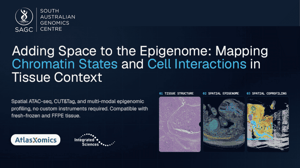
Adding Space to the Epigenome – Mapping Chromatin States and Cell Interactions in Tissue Context

Post-Event Summary:

Adding Space to the Epigenome – Mapping Chromatin States and Cell Interactions in Tissue Context

The ability to profile gene expression within intact tissues has transformed spatial biology. The next frontier is understanding the epigenetic mechanisms that regulate cell identity, function, and tissue organisation within their native spatial context.

Hosted by AtlasXomics and Integrated Sciences, this seminar explored the rapidly evolving field of spatial epigenomics, introducing researchers to technologies that map chromatin accessibility, histone modifications, and other regulatory features directly within intact tissue sections.

If you missed the session—or would like to revisit the presentation—you can watch the recording below and access additional resources to learn more about AtlasXomics' spatial epigenomic technologies. 
AtlasXomics LatchBio

AtlasXomics LatchBio Data Analysis Tutorial and GitHub page

Mouse Spleen Protein Clustering (1)
Spatial Gene and Protein Expression of Mouse Spleen Fresh Frozen Tissue
Mouse Thymus Gland Spatial Protein
Spatial Gene and Protein Expression of Mouse thymus Fixed Frozen Tissue

Additional Resources

Learn more about the AtlasXomics technology platform, applications, workflows and data analysis.

Continue exploring AtlasXomics' spatial epigenomic technologies using the resources below.

Visit the AtlasXomics website

AtlasXomics LatchBio Tutorial

AtlasXomics GitHub


Publications

Explore recent publications demonstrating the application of AtlasXomics technologies across a range of biological systems.

View AtlasXomics publications


Interested in discussing how spatial epigenomic technologies could support your research?

Contact the SAGC to learn more about our Spatial services - The SAGC can assist with project planning, experimental design, sequencing, bioinformatics, and downstream data analysis.

COMMENTS

RELATED ARTICLES