.png?width=300&name=ONCOLOGY%20-%20Novel%20Targets%20in%20Blood%20and%20Brain%20Cancer%20(1).png)
ONCOLOGY - iPSC-DERIVED NK CELLS
A new model for generating iPSC-derived NK Cells validated using single cell RNA sequencing
Natural killer (NK) cells offer exciting potential for cancer immunotherapy because of their innate ability to target and destroy tumor cells without the need for prior sensitization. They can recognize and kill cancerous or virally infected cells through direct cytotoxicity and by releasing cytokines that modulate the immune response. NK cells are particularly effective at eliminating cancer cells that evade the adaptive immune system, and their function can be enhanced through techniques like chimeric antigen receptor (CAR) engineering.
NK cells are difficult to obtain from traditional donor sources because peripheral blood provides a limited supply, and the quality of NK cells varies between donors. When expanded in vitro, they can lose their effectiveness (functional exhaustion), and modifying them through gene editing is complex. These limitations make alternative sources, like iPSC-derived NK cells, highly appealing.
Recent work led by Dr. Gustavo R Rossi (Guimaraes Group - Translational innate immunotherapy, The University of Queensland) detailed a two-step method for generating high-purity Natural Killer cells from an induced pluripotent stem cell (iPSC) derived cell lines (iNK cells). These iNK cells displayed key NK cell markers and enhanced cytotoxicity, showed resilience to cryopreservation, and their cytotoxic potential was further improved by incorporating a chimeric antigen receptor (CAR) construct.
“A key advantage of the technology was being able to fix our cells from various sources at different time points, and safely ship them to the SAGC for barcoding and sequencing.” says Dr. Fernando Guimaraes.
Having a scalable and consistent source of iNK cells would help address current limitations in traditional NK cell sources, and has the potential to play an exciting role in cancer immunotherapies.
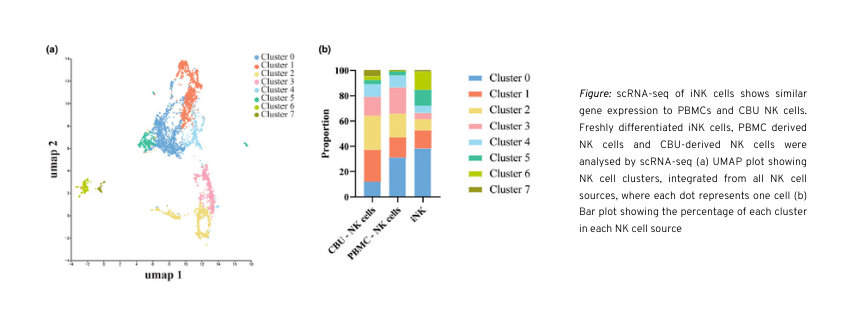
Single Cell RNA Sequencing using Parse Biosciences Evercodeᵀᴹ combinatorial barcoding technology: An important element of this study was comparing transcriptomic profiles of NK cells derived from iPSC with those derived from peripheral blood (PBMC) and cord blood units (CBU). Dr. Fernando Guimaraes and Gustavo became interested in using the Evercodeᵀᴹ technology for their experiment, because of the advantage of being able to fix and store cells from different sources across different time points, and batch together for processing and sequencing. This led them to the SAGC, who with the support of Dr. Jiyoti Verma (Field Application Specialist from Decode Science) conducted the combinatorial barcoding workflow and performed deep sequencing of the libraries on the MGI DNBSEQ G400.
Single Cell Data Processing: RNA sequencing data was analysed using Trailmaker, Parse Bioscience’s pipeline that aligns reads to a reference genome, generates gene count matrices and performs various QC steps, like filtering out low quality cells and removes doublets etc.
GR Rossi et al. Immunology & Cell Biology 2024; 1–11